


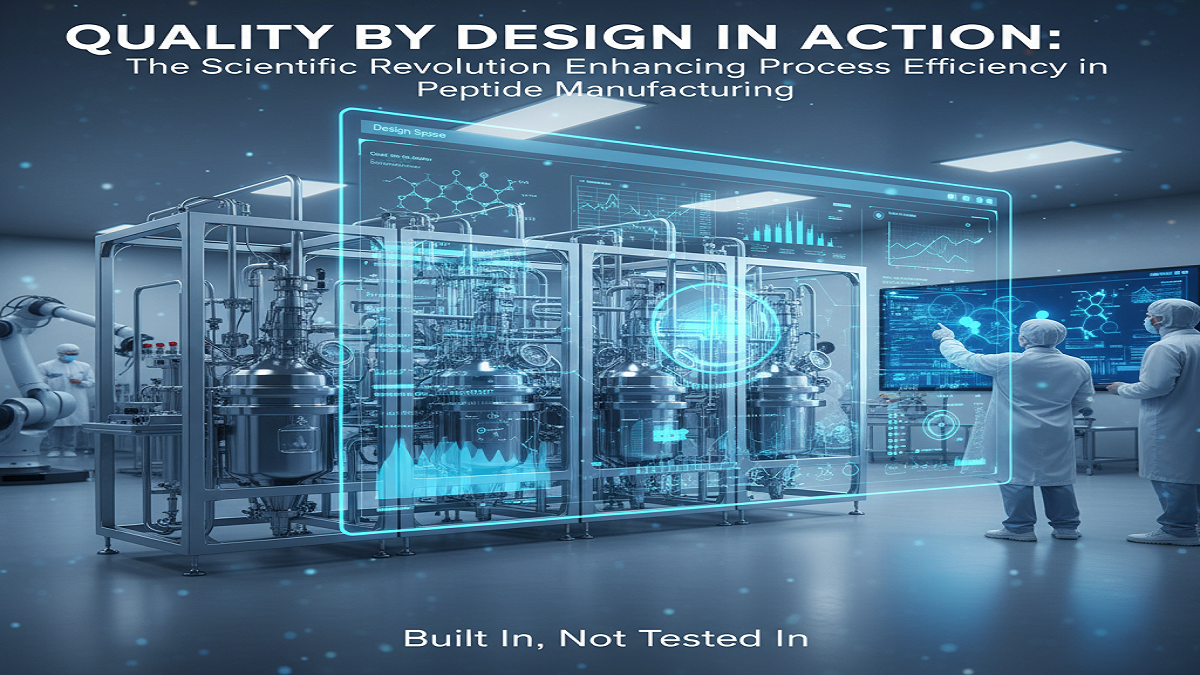
The global demand for peptide therapeutics—a class of drugs including blockbuster diabetes and obesity treatments—is skyrocketing, putting immense pressure on manufacturers to scale production while maintaining uncompromising quality. The traditional ‘Quality by Testing’ approach, which relies on inspecting the final product for flaws, is proving costly and inefficient for the complex, multi-step process of peptide synthesis.
The solution driving the industry’s efficiency renaissance is Quality by Design (QbD), a systematic, science- and risk-based framework that mandates quality must be “built in, not tested in.” For the intricate chemistry of Solid Phase Peptide Synthesis (SPPS), QbD is not merely a regulatory compliance exercise; it is a fundamental shift toward predictive manufacturing that maximizes yield, minimizes waste, and accelerates drug delivery.
Historical Foundation: From Juran to ICH
The concept of Quality by Design was first articulated by quality guru Joseph M. Juran in the mid-20th century, but its adoption in the pharmaceutical industry is a relatively modern phenomenon. Historically, drug manufacturing was viewed as an art more than a science, where regulatory filings were based on a “recipe” derived from a few successful batches. This rigid approach discouraged innovation and made even minor process changes an arduous, lengthy regulatory hurdle.
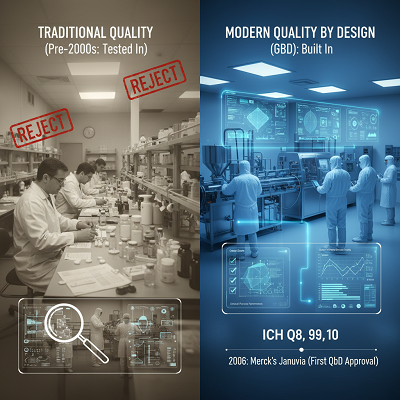
The paradigm shifted in the early 2000s when the U.S. FDA, followed by the International Conference on Harmonisation (ICH), began advocating for a new approach. The resultant ICH guidelines—Q8 (Pharmaceutical Development), Q9 (Quality Risk Management), and Q10 (Pharmaceutical Quality System)—established the QbD framework, encouraging manufacturers to:
- Define a Quality Target Product Profile (QTPP).
- Identify Critical Quality Attributes (CQAs) of the drug.
- Identify Critical Process Parameters (CPPs) that affect the CQAs.
- Define a Design Space—the multidimensional combination of input variables and process parameters that has been demonstrated to provide assurance of quality.
By 2006, the approval of Merck’s Januvia marked a significant milestone as one of the first products approved based on a QbD filing, validating the new science-based pathway.
QbD in Peptide Manufacturing: Taming Complexity
Peptide synthesis is notoriously complex, involving repeated coupling, washing, and cleavage steps, each of which can introduce impurities (e.g., deletions, truncated sequences). Applying QbD to this process focuses strategically on the highest-risk, most variable steps:
1. Identifying Critical Steps and Attributes
| Peptide Process Step | Critical Process Parameter (CPP) | Critical Quality Attribute (CQA) |
| Solid Phase Synthesis (SPPS) | Reaction Temperature, Coupling Time, Reagent Concentration | Purity/Impurity Profile, Sequence Integrity |
| Cleavage/Deprotection | Acid Concentration, Reaction Time | Crude Purity, Yield, Residual Solvents |
| Purification (HPLC) | Solvent Gradient, Flow Rate, Column Loading | Final Purity, Impurities/Byproducts |
| Isolation & Lyophilisation | Freezing Rate, Primary/Secondary Drying Time, Vacuum | Moisture Content, Bulk Density, Stability |
2. The Power of Enhanced Process Understanding
Instead of conducting trial-and-error, peptide manufacturers use Design of Experiments (DoE)—a statistical tool central to QbD—to systematically challenge their process. For example, by deliberately varying the coupling time and reagent stoichiometry (CPPs) in SPPS, they can map the exact impact on the final peptide purity (CQA). This mapping defines the Design Space, allowing process engineers the flexibility to make changes within that approved space without requiring a new regulatory submission.
Current and Upcoming Trends: The Digital Leap ��
The next wave of efficiency in peptide QbD is being driven by the convergence of automation and advanced computing.
- Process Analytical Technology (PAT): PAT tools, which allow for real-time monitoring and control of the process, are key to realizing the QbD vision. In peptide manufacturing, this includes in-line or on-line spectroscopy (e.g., Raman or Near-Infrared) to monitor the progress of coupling reactions, determine endpoint, and track impurity formation in real-time. This ability to “look” inside the reactor drastically reduces cycle time and ensures every reaction is driven to completion optimally.
- Continuous Manufacturing (CM): The shift from batch to continuous manufacturing is a natural evolution of QbD. For peptides, this involves modular, integrated flow chemistry systems where the synthesis, cleavage, and purification steps are performed continuously. QbD provides the science-based understanding to build the Control Strategy for these complex, interconnected systems, resulting in smaller footprints, higher quality consistency, and dramatically increased throughput.
- AI and Machine Learning (ML): The large datasets generated by DoE and PAT are increasingly being analyzed by ML algorithms. AI can build predictive models that forecast the impact of a minor raw material variability on the final peptide purity. This enables proactive control, where the system automatically adjusts a CPP (like solvent flow) to prevent a deviation before it even occurs, ushering in the age of the self-optimizing plant.
Expert Opinion and Implications
Dr. El Djouhar Rekai, a Head of Process Development and Manufacturing Life Cycle Management, emphasizes the strategic investment required: “The journey to an efficient commercial peptide process is founded on an in-depth investment in the control strategy design. QbD, coupled with PAT, allows us to set robust control limits in development, which are then consolidated and demonstrated in validation. It moves us from simply reacting to batch failures to predicting and preventing them.”
The implications of QbD in peptide manufacturing are profound:
- Financial Efficiency and Reduced Time-to-Market: By minimizing the reliance on costly, late-stage testing and virtually eliminating batch failures, manufacturers achieve a “Right First Time” success rate. This drastically cuts down on material waste, rework, and the time spent in development, ultimately accelerating the drug’s journey to the patient.
- Regulatory Flexibility and Lifecycle Management: Once a Design Space is approved, manufacturers can continuously improve their process (e.g., for yield or cost reduction) within that established space without the time and cost associated with post-approval change submissions.
- Robustness for Novel Peptides: As the industry moves toward highly complex, customized, and sometimes cyclized or modified peptides for personalized medicine, QbD provides the only systematic method to manage the unique variables and risks of these novel molecules, ensuring their quality and reproducibility at scale.
In short, QbD transforms the peptide synthesis process from a rigid recipe into a dynamic, scientifically-understood system. It is the essential infrastructure for the next generation of life-changing peptide medicines.