
The pharmaceutical and life sciences industries are navigating a labyrinth of increasingly complex global regulations, a challenge that is driving a fundamental shift in how companies manage compliance. Regulatory affairs, once a rigidly in-house function, is rapidly moving toward sophisticated outsourcing models, transitioning from simple task delegation to long-term, strategic partnerships. This evolution is not just a trend; it’s a structural transformation fueled by a need for specialized expertise, cost-efficiency, and unprecedented agility.
Background and Historical Context
The outsourcing of pharmaceutical functions is not new, tracing its roots back to the desire to cut costs in non-core areas like manufacturing and logistics. However, regulatory affairs (RA) has historically been more resistant to full-scale outsourcing due to its sensitive nature, involving core intellectual property (IP) and direct interaction with health authorities.
From Tactical to Transformational
In the early days of RA outsourcing, it was primarily a tactical move—a means of staff augmentation to manage predictable spikes in workload, such as compiling submissions or handling simple post-approval maintenance for non-priority markets. These were typically transactional, fee-for-service arrangements.
However, a confluence of factors has pushed the industry toward more strategic models over the last decade:
- Escalating Complexity: The rise of complex modalities like biologics, cell, and gene therapies demands niche expertise that is difficult and costly to maintain in-house.
- Globalization of R&D: Companies are pursuing simultaneous drug approvals across multiple, diverse regulatory jurisdictions, requiring immediate access to global-to-local intelligence.
- Cost Pressures and Downsizing: In the wake of major mergers, acquisitions, and patent cliffs, large pharma has sought to reduce fixed overheads and channel internal resources toward core R&D and strategic innovation.
This shift has moved regulatory outsourcing from an optional cost-saver to a strategic imperative, transforming it into a high-growth market expected to surpass $15 billion by 2030, according to industry estimates.
Current and Upcoming Trends in Outsourcing Models
Today’s models prioritize deep integration, shared risk, and technology enablement, moving far beyond basic staff augmentation.
1. The Rise of the Functional Service Provider (FSP) Model
The Functional Service Provider (FSP) model has emerged as the dominant strategic engagement. Unlike the traditional full-service outsourcing (FSO) model—where a vendor manages an entire project end-to-end—the FSP model sees the client outsource a specific function or department across multiple projects.

- Key Characteristics:
- Strategic Integration: The FSP team is often embedded virtually or physically, operating as a dedicated, managed extension of the client’s internal regulatory department.
- Specialization: It’s heavily favored for high-volume, repetitive, or niche tasks like CMC (Chemistry, Manufacturing, and Controls) regulatory writing, labeling management, or post-approval lifecycle maintenance for established product portfolios.
- Scalability: It offers unparalleled flexibility, allowing companies to scale resources up or down quickly based on pipeline demands without altering internal headcount.
2. Digitalization and AI Integration ��
Technology is the accelerant for the new wave of outsourcing. Service providers are increasingly leveraging advanced digital tools to drive efficiency, compliance, and real-time intelligence.

- Automation of Routine Tasks: Artificial Intelligence (AI) and Machine Learning (ML) are being deployed to automate the compilation of regulatory dossiers, perform structured content authoring, and monitor changes in global regulations, allowing human experts to focus on complex strategy.
- Cloud-Based Platforms: The adoption of unified, cloud-based regulatory information management (RIM) systems is critical. Outsourcing partners managing the client’s RIM system can provide a single source of truth for all regulatory data, improving transparency and facilitating seamless global submissions.
3. Shift to Strategic, Outcome-Based Partnerships
The future is moving away from hourly or full-time equivalent (FTE) contracts toward outcome-based models. Companies are seeking partners who will share accountability for results, such as achieving a specific market approval within a defined timeframe.
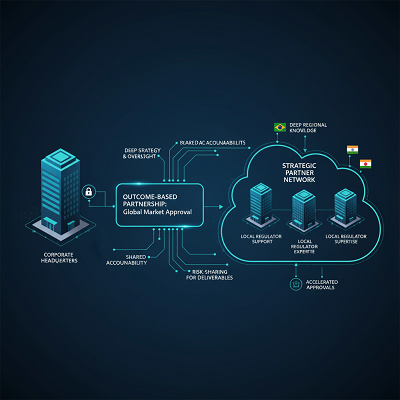
- Focus on Global-to-Local Expertise: With regulatory harmonization ongoing but far from complete, firms are increasingly outsourcing local regulatory support in smaller or emerging markets to partners who possess established in-country presence and deep regional knowledge. This allows corporate headquarters to maintain tight control over core global strategy.
Expert Opinions and Implications
Industry leaders see these trends as essential for survival and innovation in the modern pharmaceutical ecosystem.

Expert Insight: Focus on Core Competency
“The modern pharmaceutical company must be laser-focused on its core competency: drug discovery and commercialization strategy,” says one former VP of Regulatory Affairs for a top-10 biopharma firm. “Everything else—especially the routine, high-volume, yet critical compliance tasks—is fair game for strategic outsourcing. If a partner can deliver 20% efficiency gains in dossier maintenance, that frees up my internal senior strategists to concentrate on getting our groundbreaking oncology therapy to the FDA faster.”
Implications for the Industry
The strategic pivot to regulatory outsourcing has profound implications:
| Area | Implication |
| For Pharma Companies | Focus on Innovation: Reduced operational burden allows greater investment in R&D. Cost Efficiency & Agility: Lower fixed costs and ability to rapidly scale to meet pipeline fluctuations. Risk Mitigation: Access to global expertise ensures adherence to diverse, evolving regulations, lowering the risk of inspection failures or delayed approvals. |
| For Service Providers (CROs/CSOs) | Increased Accountability: A shift from vendors to true strategic partners, requiring greater transparency and a willingness to share risk for deliverables. Technology Investment: Necessity to invest heavily in AI, data analytics, and robust, secure IT infrastructure to remain competitive. |
| Key Challenges | Data Security and IP Protection: Outsourcing sensitive regulatory data requires extremely robust contracts and high-security IT protocols. Governance and Oversight: Maintaining control and consistent quality across highly integrated, outsourced functions demands clear KPIs and a strong governance model. |
In conclusion, the era of transactional outsourcing is ending. The new competitive edge in the pharmaceutical world belongs to companies that can master the art of collaborative, technology-driven regulatory partnerships. By strategically externalizing the complexities of compliance, the industry is not just saving money; it’s building a more agile, resilient, and ultimately, faster pathway to bring life-saving therapies to patients worldwide.